Global Enrolment Survey Reveals Impact of Visa Processing and Government Policy
Half of universities saw falling enrolments while those that saw gains cited new programmes, flexible start dates, and other institutional initiatives
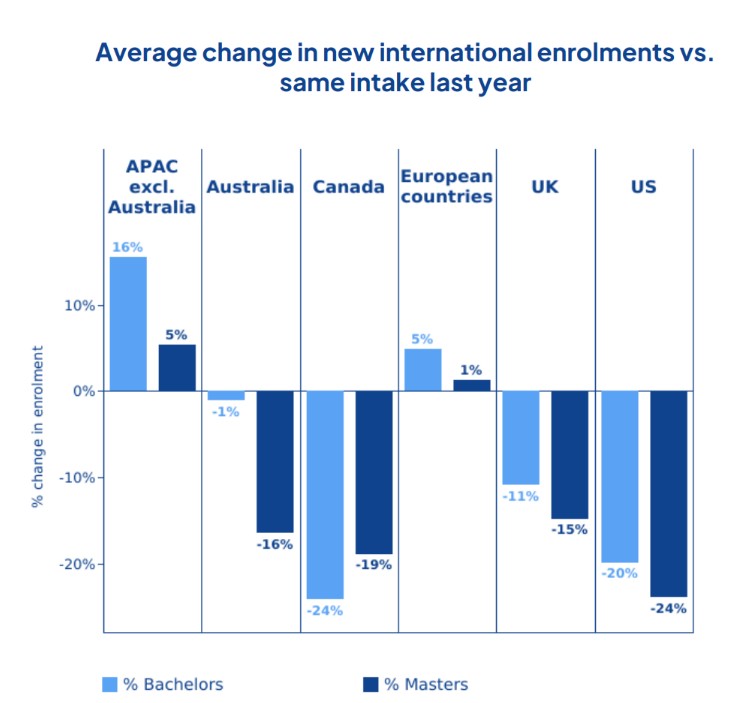
Half of universities surveyed reported lower new international student enrolments in January through March 2026 compared to the same intake last year. The ‘‘Big Four’ destinations Australia, Canada, the UK, and the US are seeing the sharpest enrolment drops. European countries and APAC countries, with the exception of Australia, reported enrolment growth.
This is according to the latest Global Enrolment Benchmark Survey by NAFSA, Oxford Test of English, and Studyportals. The survey includes responses from 254 universities across 36 countries.
Policy restrictions are the number one problem, followed by affordability
Nearly three in four universities (73%) said restrictive government policies and issues obtaining visas were significant factors affecting enrolment. Two-thirds (67%) said it was the biggest negative influence.
Respondents worldwide report unwelcoming policies, higher visa refusal rates, processing delays, and increased scrutiny—resulting in missed deadlines, late arrivals, and lost students. Frequent policy changes and uncertainty around post-study work pathways are adding to students’ concerns.
Cost is cited as the other major pressure. Half of universities said affordability and cost of living were holding students back. Scholarships, fee waivers, competitive discount rates, and targeted financial aid were flagged as influencing student decisions.
Institutional action fuels enrolment gains
Where institutions report positive influences on international enrolment, these are overwhelmingly tied to factors they can directly influence. Launching new programmes was the most commonly cited reason for enrolment growth. Market diversification and strategic marketing came next. Several universities reported the introduction of January start dates to manage visa issuance uncertainty and to attract students who would otherwise defer or drop out of the cycle.
The factors contributing positively to enrolment growth differed by region, with US institutions emphasising student transfers and athletics recruitment. UK institutions relied more on increasing scholarships and financial incentives and on increasing yield, while European institutions were more likely to attribute enrolment growth to new programmes and activities on social media. Market positioning was key for institutions in APAC, while Canadian institutions emphasised recruitment partners to increase enrolments.
Looking ahead: New markets and tighter budgets
Looking ahead, diversifying into new markets is the top priority for universities over the coming year. Budget cuts are the second most anticipated change.
The Global Enrolment Benchmark survey offers real-time international student enrolment data gathered from institutions worldwide. The survey offers a comparable view on global student flows across countries, well before official national figures are available.
Fanta Aw, PhD, Executive Director and CEO of NAFSA: Association of International Educators says, “Despite an increasingly uncertain policy environment, the survey shows that institutions willing to innovate and adapt can still create meaningful pathways for student success and access. Therefore, student flows depend on both institutional resilience and policies that enable, rather than restrict, global talent mobility. Institutions can and must exercise greater agency to counter serious external forces.”
Edwin van Rest, CEO of Studyportals says, “The enrolment winter facing the Big Four destinations has intensified to a ‘Blizzard’, and emerging markets are capturing the window of opportunity it brings. This data provides a ‘weather report’ on how the sector climate is shifting globally, months or even years before the official statistics will be out. Most importantly, it supports institutions understanding the obstacles, the opportunities, and a path to sustainable recovery”
Sara Pierson, Managing Director, English Assessment at Oxford University Press says, “Universities are increasingly rethinking how they assess English proficiency as they need to diversify and expand their international student base. The focus is shifting from testing isolated language skills to understanding how effectively students can use English in real academic and social contexts. The findings reflect the challenge that is being felt across the sector, with 23% of institutions in Canada and Europe reporting difficulties in meeting English proficiency requirements. This points to a need for more integrated, authentic approaches to assessing and supporting students for success in higher education.”
About NAFSA: Association of International Educators
NAFSA is the world’s largest and most comprehensive nonprofit association dedicated to international education and exchange.
About Oxford Test of English
The Oxford Test of English, Oxford Test of English Advanced, and Oxford Test of English for Schools are award-winning English proficiency tests that have been developed by Oxford University Press (OUP) and endorsed by the University of Oxford.
About Studyportals
Studyportals is the world’s most comprehensive study choice platform, helping over 40 million students to choose their best-fit study across 245,000+ English-taught programmes from 3,500+ institutions in 118 countries.
About the Global Enrolment Benchmark Survey
Delivered in collaboration with NAFSA, Studyportals, and Oxford Test of English, the Global Enrolment Benchmark Survey is trusted by institutions in over 70 countries — and proudly supported by EAIE, APAIE, CBIE and UUKi
Press Contacts:
Studyportals: Cara Skikne: caraskikne@studyportals.com
NAFSA: Erica Stewart: erica.stewart@nafsa.org
Oxford Test of English: Simone Emmison: Simone.Emmison@oup.com