International students turn away from the US and Canada as policy barriers intensify

461 universities from 63 countries reported their enrolment numbers for August to October 2025. The picture that emerged isn’t just about numbers dropping or rising. It’s about entire recruitment pipelines shifting in real time.
Canada and the US watched students disappear
Canadian universities reported the worst numbers globally: down 36% in undergraduate enrolment and 35% in postgraduate. US institutions saw undergraduate numbers drop 6% and postgraduate fall 19%.
That’s not a slight dip. That’s losing nearly two in every five students in a single year for Canada. For the US, it’s nearly one in five postgraduate students gone.
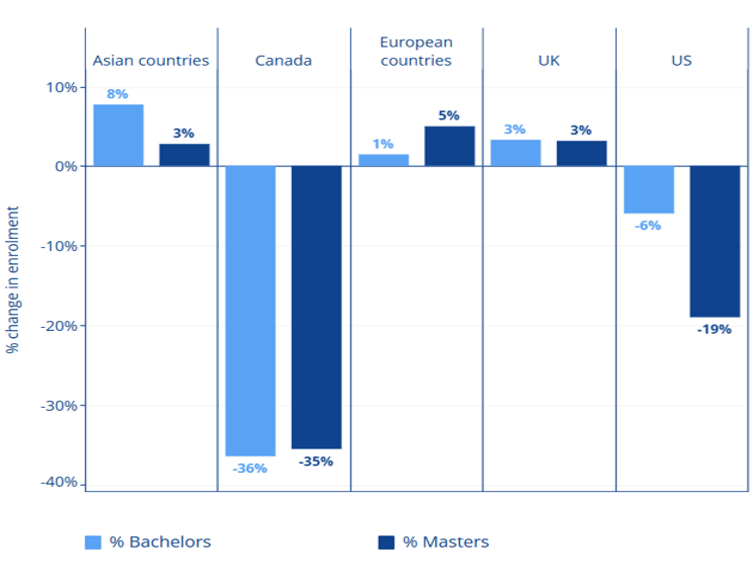
One Asian institution explained what happened: “The Big Four countries’ policies gave favorable opportunity for East Asian countries.” Translation: when visa restrictions tighten in traditional destinations, students go somewhere else. And they went east.
Survey responses from European universities said their institution recruited “More applicants who would previously have applied to the US and Canada.” The students didn’t vanish. They just changed where they applied.
Policy became the dominant concern
68% of universities globally cited restrictive government policies as a major problem. Last year, that number was 51%. In one year, policy concerns jumped 17 percentage points.
The US saw the sharpest increase: 85% of institutions now cite policy barriers, up from 58% in 2024. That’s a 27-point jump.
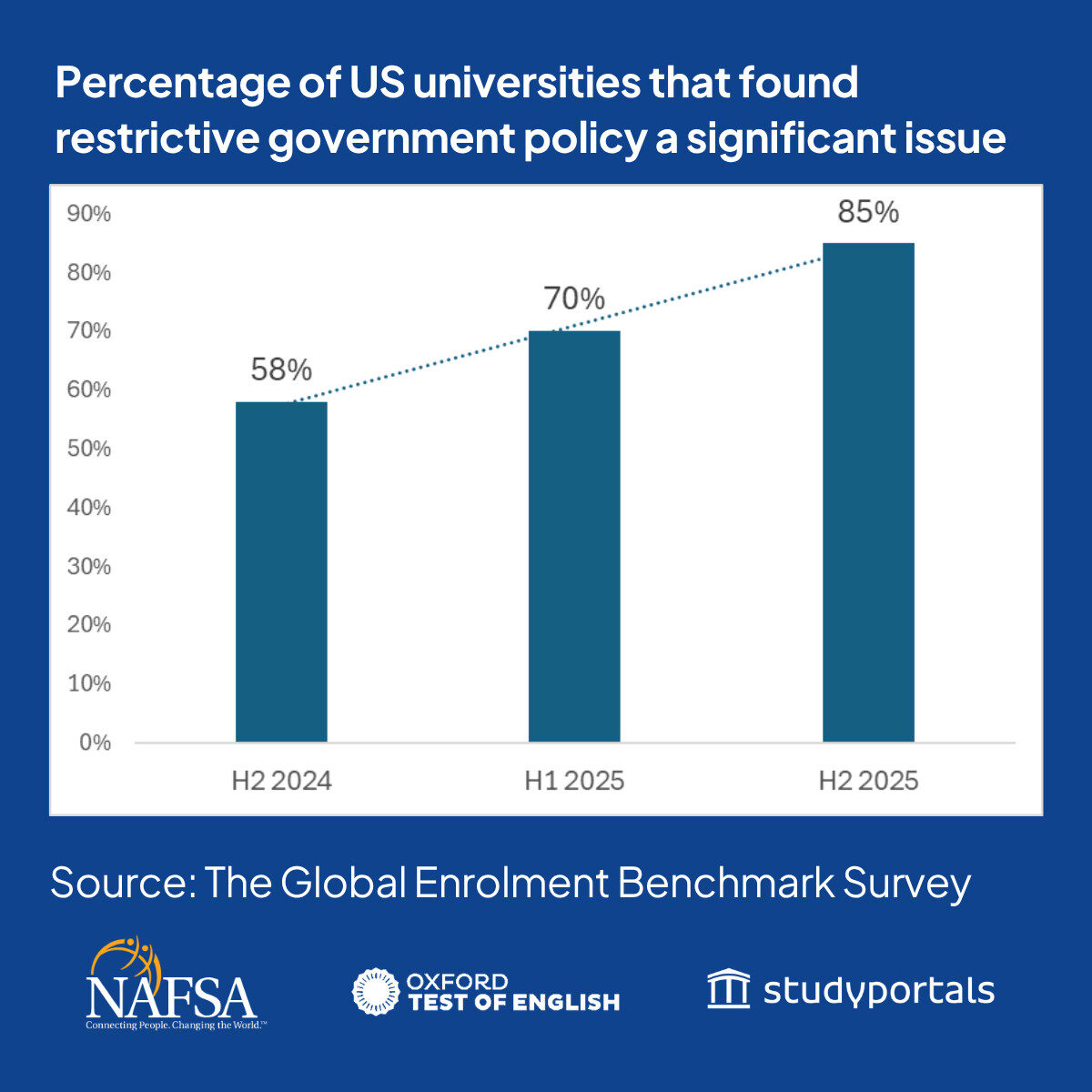
Survey responses were blunt about what changed. One US institution: “Anti-immigrant statements and uncertainty about policy changes.” Another: students are choosing countries “with clearer, more welcoming policies.”
Dr. Fanta Aw, CEO of NAFSA: Association of International Educators says:
The ripple effects of these policy changes are being felt across campuses and communities around the world. This moment calls on our higher education institutions to be nimble and deeply attuned to the needs of their students.
The pattern is clear: policy drives enrollment. When visa restrictions tighten, students choose different destinations. Universities either adapt or watch their numbers fall.
The ones growing right now aren’t necessarily the ones with the best programmes or biggest budgets. They’re the ones who saw the data early and moved before their competitors did.
Edwin van Rest, CEO and co-founder of Studyportals says:
As the tides of politics ebb and flow, universities can be responsive by leveraging forward-looking data. This enables institutions to navigate uncertainty, drive innovation, and keep optimising for the long term. Higher ed will remain international and the race for talent will only speed up, even if some governments don’t have their eye on that ball for a while.