Türkiye’s value advantage: Turning affordability into international student growth
 Arunima Dey
 Ameena Ali
As the cost of international education continues to rise, Türkiye is attracting growing interest from students looking for quality education at a more affordable price.
Low public university tuition fees, competitively priced private institutions, and extensive scholarship opportunities have helped position the country as a strong value-for-money study destination. This is particularly relevant for students in cost-conscious markets, where affordability remains an important factor in study decisions.
This article explores where demand for Türkiye is coming from, how its pricing compares with major study destinations, and which fields of study may offer the strongest opportunities for future growth.
Nearly 40% of international student demand comes from three South Asian markets
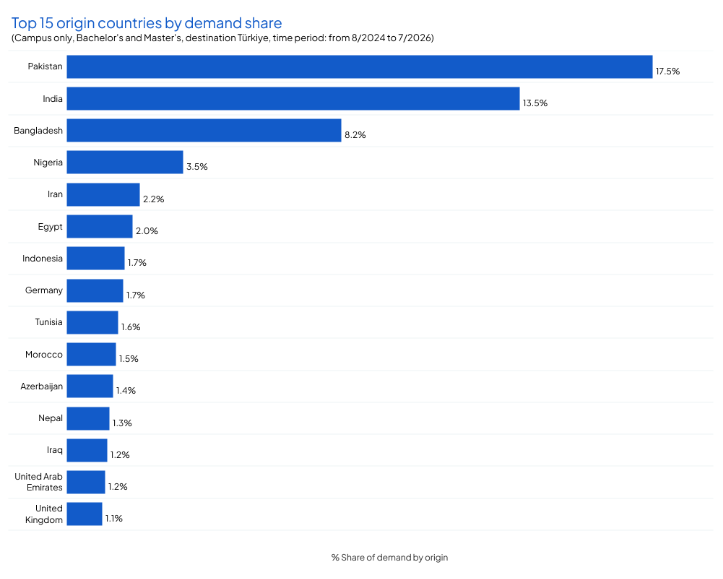
Türkiye’s international student demand is heavily concentrated in a small number of countries. Pakistan (17.5%), India (13.5%), and Bangladesh (8.2%) together account for almost 40% of total demand, making South Asia the largest source region for student interest in Türkiye.
Affordability may be one factor contributing to this demand, but market size is also important. India, Pakistan, and Bangladesh are among the world’s most populous countries and generate large numbers of internationally mobile students. Their prominence in Türkiye’s demand profile likely reflects both the size of these markets and Türkiye’s attractiveness as a destination.
This concentration creates both opportunities and challenges. Türkiye has an opportunity to further strengthen its position in South Asia, while also exploring ways to diversify recruitment across a wider range of markets.
At the same time, it is important to distinguish between demand and enrolment outcomes. Student interest observed today may not translate into enrolments for one or more academic cycles, while factors such as economic conditions, visa policies, scholarship availability, and competition from other destinations can influence final decisions.
Turkish tuition fees remain a fraction of those in the Big Four destinations
The strong demand coming from South Asia and other emerging markets suggests that affordability may be one of Türkiye’s key competitive advantages.
A comparison with the traditional “Big Four” destinations highlights the scale of that difference.
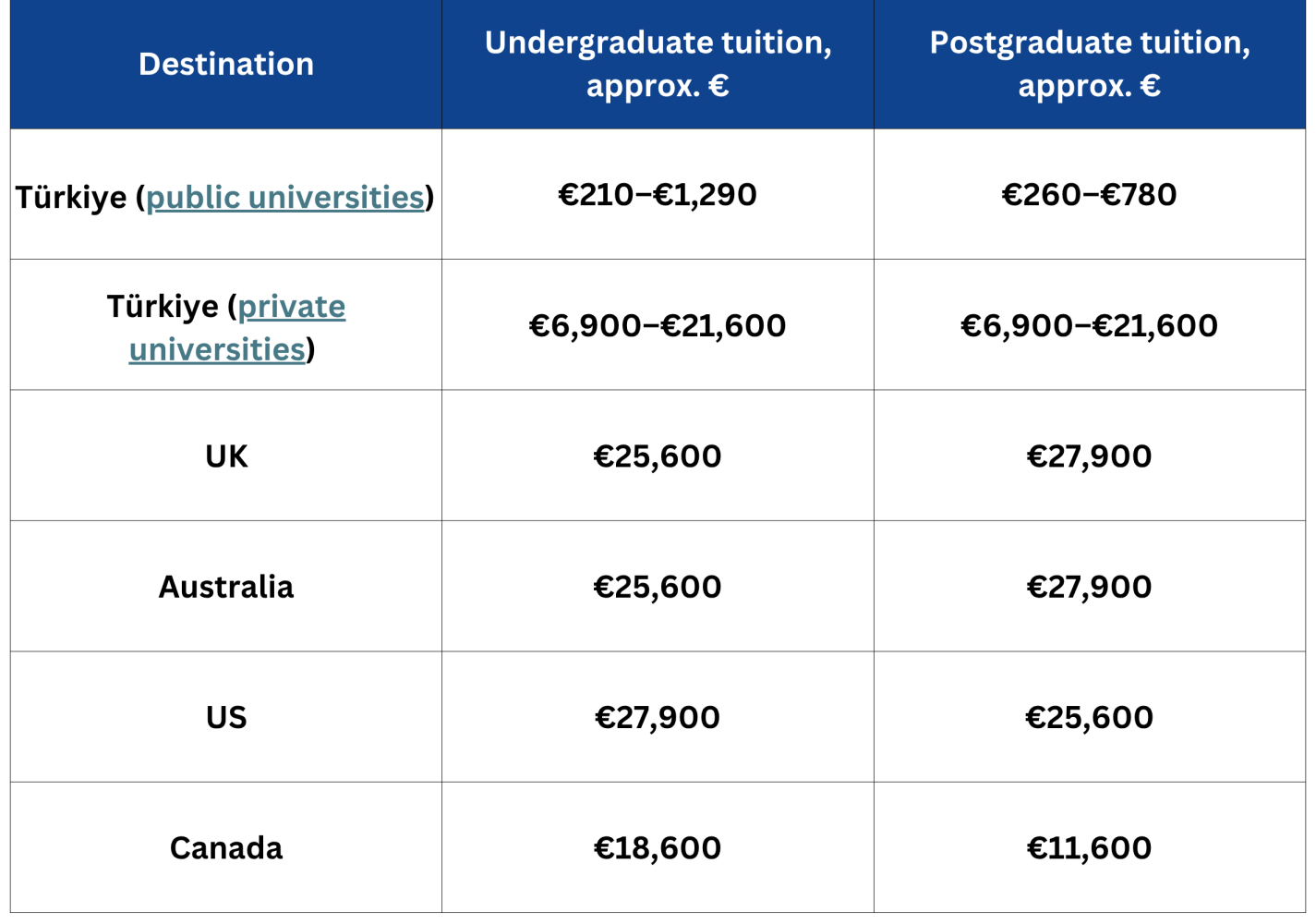
A master’s degree at a Turkish public university can cost less than €1,000 per year. By comparison, average postgraduate tuition fees exceed €11,000 in Canada and €25,000 in the UK, Australia, and the US.
Even many private universities in Türkiye remain competitively priced compared with average tuition fees in major study destinations.
If destinations such as the UK, Australia, and the US often compete on reputation and prestige, Türkiye’s affordability gives it a distinctive position in the international education market.
Demand is strongest for programmes below €1,000, but students are willing to pay for value
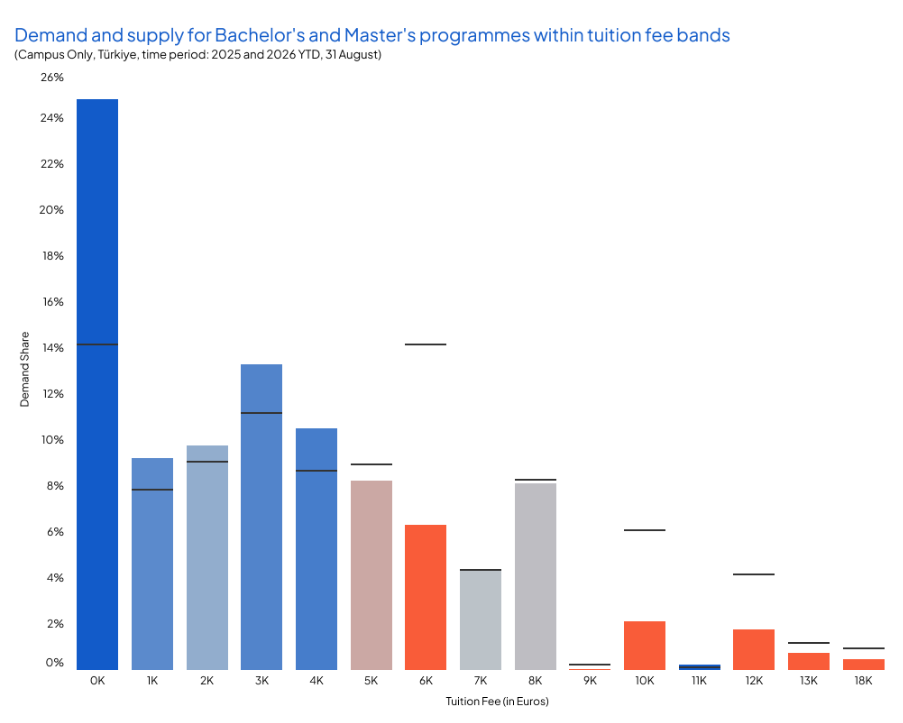
Demand is heavily concentrated in programmes priced below €1,000, accounting for almost a quarter of all student interest.
This aligns closely with Türkiye’s public higher education system, where many bachelor’s and master’s programmes fall within this price range. It also reflects a broader global pattern, as student demand tends to cluster around lower tuition-fee bands across many study destinations.
Demand remains present across fee bands between €1,000 and €4,000, before becoming more dispersed at higher price points. This suggests that affordability continues to influence student preferences even within a relatively low-cost destination.
However, students are not exclusively pursuing the cheapest options.
Several fee bands between €3,000 and €8,000 continue to attract meaningful demand. This may indicate that students are willing to pay higher fees when they perceive additional value through factors such as institutional reputation, programme quality, English-language provision, or subject specialisation.
As of 2026, Studyportals lists more than 2,200 bachelor’s and master’s programmes taught in English in Türkiye.
The broader takeaway is that Türkiye’s appeal appears to be based on a combination of affordability and perceived value, rather than low cost alone.
Scholarships strengthen Türkiye’s affordability advantage
Low tuition fees are only part of Türkiye’s value proposition.
The government-funded Türkiye Scholarships programme currently supports around 15,000 international students and awards approximately 5,000 new scholarships each year.
The programme covers a range of study-related costs, including tuition fees, Turkish language classes, accommodation, and health insurance. Its global reach is reflected in the 121,830 applications received from 170 countries in 2024.
Alongside the national scholarship scheme, universities such as Koç University, Bilkent University, and Sabancı University also offer institution-level financial support.
Together, these initiatives help reduce financial barriers and strengthen Türkiye’s position as an accessible destination for international students.
The biggest growth opportunities are not always in the biggest disciplines
Affordability may help attract students, but programme choice ultimately determines where demand translates into opportunity.
Looking at demand and supply across disciplines reveals an important distinction between areas with the highest demand and areas where demand appears stronger than programme availability.
Business & Management and Social Sciences account for large shares of student demand, but programme availability broadly keeps pace with interest, suggesting these are relatively mature markets.
Engineering & Technology presents an even more competitive picture. Despite attracting one of the largest shares of demand, it also appears to have a high level of programme availability, indicating a more saturated market.
This suggests that the largest disciplines are not necessarily the disciplines with the greatest growth potential.
Healthcare, technology and science show some of the strongest opportunity gaps
Some of the clearest opportunities appear in disciplines where student demand is relatively high compared with programme availability.
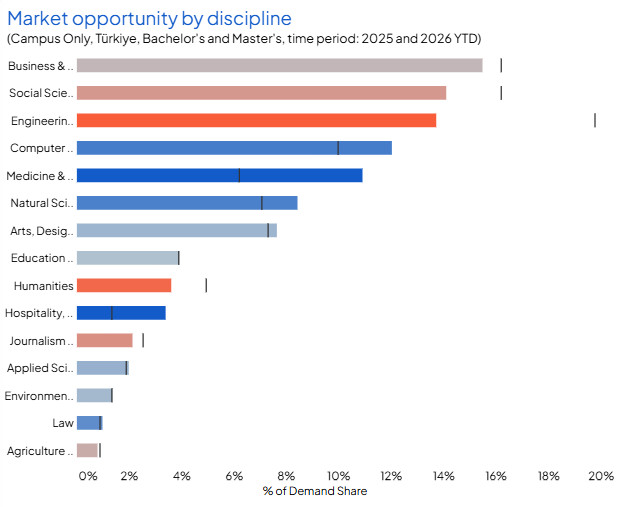
Medicine & Health stands out as an area where demand appears to exceed supply, while Computer Science & IT combines a large demand base with a sizeable opportunity gap.
Natural Sciences & Mathematics and Arts, Design & Architecture also show favourable demand-supply dynamics, suggesting room for further growth. Hospitality, Leisure & Sports represents a smaller market overall, but one where demand appears strong relative to available programmes.
Taken together, these findings suggest that future growth opportunities may be strongest in fields linked to healthcare, digital skills, scientific expertise, and specialised professional training.
Student demand is shifting towards specialised and career-focused fields
Looking beyond broad disciplines reveals a more detailed picture of changing student interests.
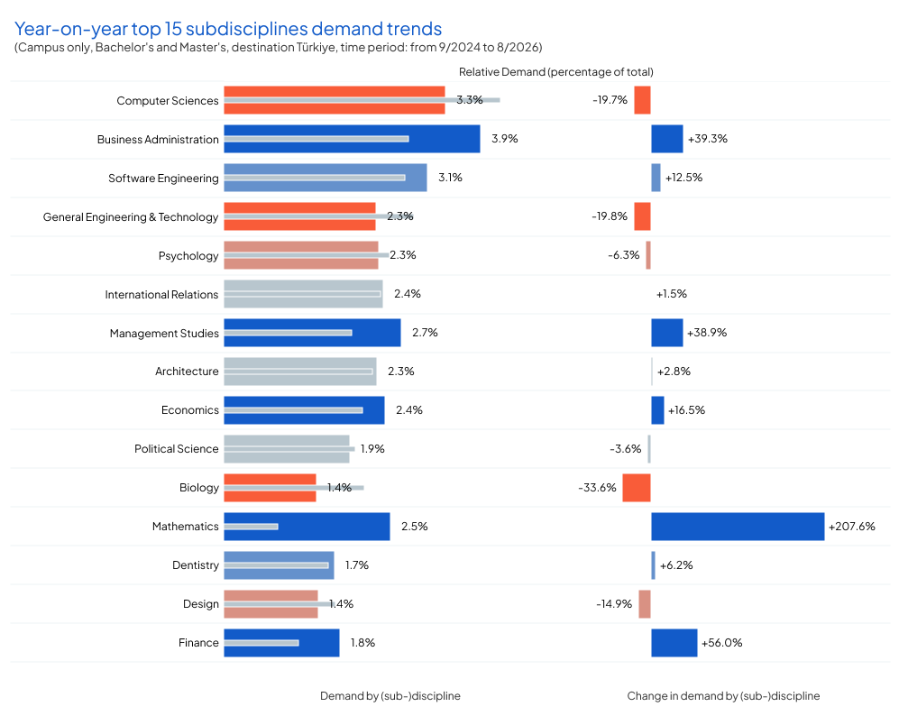
Computer Science remains the largest sub-discipline by demand share. However, demand has slightly declined alongside General Engineering & Technology, Biology, and Design, suggesting that growth is not occurring evenly across broad STEM fields.
Instead, momentum appears to be shifting towards more specialised and career-oriented subjects.
Mathematics stands out as one of the fastest-growing sub-disciplines, while Finance, Business Administration, Management Studies, and Economics have also seen strong gains.
This points to growing interest in analytical, quantitative, and business-focused skill sets that align closely with evolving labour market needs.
Türkiye’s next challenge is turning affordability into long-term growth
Türkiye already offers international education at a fraction of the cost of many competing destinations. Public university tuition fees are often measured in hundreds rather than thousands of euros, while living costs remain relatively affordable at around €400-650 per month. Scholarship opportunities further reduce financial barriers for many students.
This positioning aligns strongly with major source markets such as India, Pakistan, and Bangladesh, and may also resonate with other cost-conscious markets including Nigeria, Iran, Egypt, and Indonesia.
However, affordability alone is unlikely to drive the next phase of growth. Demand is strongest below €1,000, but students continue to show interest across a broad range of tuition-fee levels when they perceive clear value. At the same time, disciplines such as Medicine & Health, Computer Science & IT, Natural Sciences & Mathematics, Arts, Design & Architecture, and Hospitality, Leisure & Sports appear to offer some of the strongest opportunities for expansion.
The opportunity for Türkiye is not simply to remain affordable. It is to convert that affordability advantage into sustained international growth by expanding provision in high-demand areas and continuing to demonstrate value alongside competitive pricing.