From study choices to first jobs: International graduates and skills gaps

By Arunima Dey
International graduates represent an important source of talent for sectors struggling to recruit skilled workers. And the scale of that potential is significant.
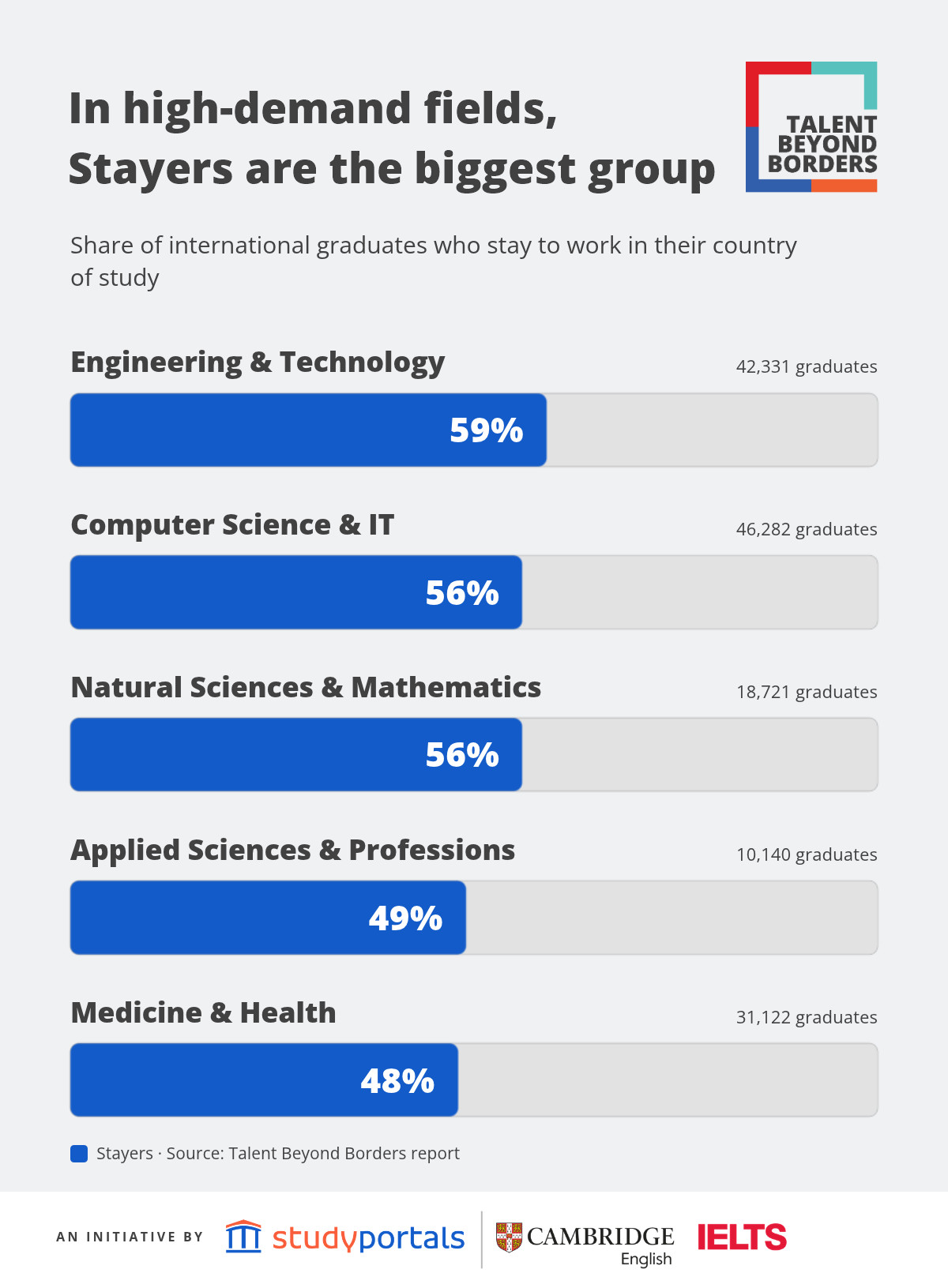
In Talent Beyond Borders, the joint initiative by Studyportals and Cambridge IELTS the Graduate Outcomes Dataset includes more than 46,000 graduates who studied Computer Science and IT, over 42,000 who studied Engineering and Technology, and 31,000 who studied Medicine and Health. These fields are connected to sectors experiencing persistent recruitment pressures.
The report draws on OECD and other workforce evidence identifying persistent shortages across sectors including Healthcare, Construction, and Transportation and storage, alongside employer-level evidence of recruitment difficulties in Manufacturing and ICT-related market services.
What happens to internationally educated talent after graduation therefore matters.
Among international graduates in the dataset who studied Engineering and Technology, 59% are Stayers, meaning their first identified job is in their country of study. Stayers also account for 56% of Computer Science and IT graduates 56% of Natural Sciences and mathematics graduates, 49% of Applied Sciences and Professions graduates, and 48% of Medicine and Health graduates. Across all these fields, Stayers are the largest mobility group.
But choosing a shortage-relevant field of study does not tell us whether graduates subsequently enter shortage-affected areas of the labour market.
The first-job data provide another part of the picture. Among international graduates in the dataset whose first identified job is in Healthcare, 57% are Stayers, 28% are Homecomers and 16% are Nomads. Among those whose first identified job is in Software and IT Services, 43% are Stayers.
These findings do not establish that a Medicine and Health graduate became a healthcare professional, or that an Engineering and Technology graduate filled a specific shortage vacancy. The dataset analyses study discipline and first-job industry separately, and more detailed occupational and country-level analysis would be needed to make that connection.
What the evidence does show is an important alignment: substantial numbers of international graduates study in fields connected to workforce shortages, while international graduates are also observed entering industries facing recruitment pressures. In several of these groups, staying to work in the country of study is the largest post-graduation pathway.
Addressing skills shortages is therefore not only about attracting talent. It is also about creating pathways that recognise international graduates’ skills, support meaningful careers and enable their expertise to strengthen fields facing persistent talent gaps.