Why universities are embracing Q1 start dates
 Cara Skikne
 Ranim Chaya

While September remains the dominant intake worldwide (particularly in the Northern hemisphere), preliminary findings from the Global Enrolment Benchmark Survey show the Q1 window is growing in strategic importance.
Introducing new programmes, and January start dates for existing programmes were some of the factors most mentioned by universities as positively impacting international student enrolments. Several universities cited the introduction of January start dates, to manage visa unpredictability and to capture students who would otherwise defer or drop out of the cycle.
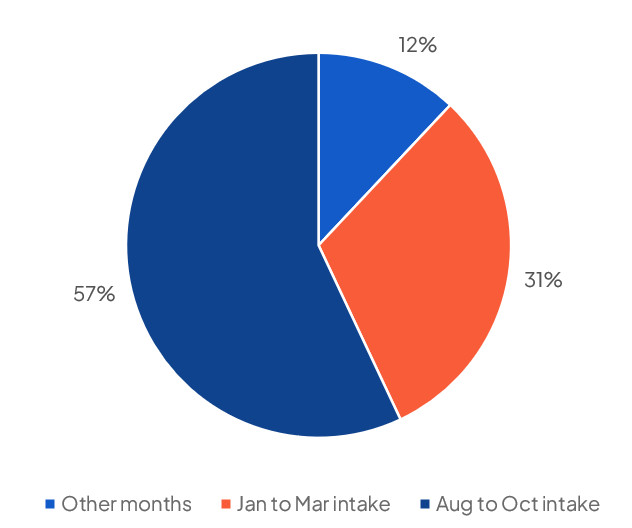
Where demand for January to March start dates is more concentrate
When we look at how total annual student demand is split across intake months, one thing stands out: the role of each intake depends a lot on the student’s country of origin. September is still the main intake worldwide, but January takes up a meaningful share of demand in some markets.
Student interest data — based on pageviews on Studyportals platforms — reveals that prospective students from certain countries show a notably stronger preference for the January to March intake than their peers elsewhere. In fact, more than a quarter of all Bachelor’s and Master’s programme interest generated by students from South Africa, Nepal, New Zealand, Australia, and Malaysia is directed toward programmes with a January to March start date.
💡What this means for recruitment
The timing of start dates matters:
- Adding and promoting Q1 programme start dates can make a real difference. Additional start dates can help manage visa delays, deferrals and uncertainty.
- One global recruitment calendar rarely works well for all markets. Understanding demand by origin country can help to prioritise marketing and recruitment activities.