International students’ interest to study in the USA up 40% after midterms, following two years of decline
A rebound in demand could help ease US talent shortages, such as the 157,000 chip workers the industry is projected to lack by 2030.
Eindhoven, Netherlands, 9 November 2026 – Relative demand from international students for on-campus study in the United States rose 40% on 8 November compared with the same day a week earlier, according to Studyportals data.
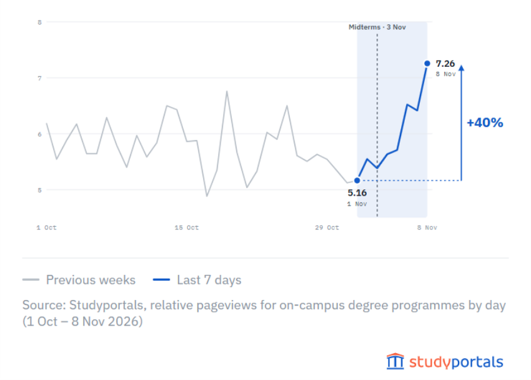
This measure tracks the US share of all international interest in on-campus programmes on Studyportals, the world’s largest platform for students choosing their higher education path. It follows nearly two years of sharp decline: the US share of student interest in bachelor’s and master’s programmes fell 38% over the last two years, and Studyportals’ Global Enrolment Benchmark Survey showed US master’s enrolments down 19% YoY in Fall 2025.
The decline coincided with tighter US policy, according to NAFSA: a rule ending “duration of status” (blocked by a court in September), narrower rules for Curricular Practical Training (under legal challenge) and a proposed fee for Optional Practical Training. These restrictions are not yet in effect and are still in process. International students now appear to expect that a Democratic House and Senate would view international talent, and its ability to build a career in the US, more favorably.
The timing matters. The US faces a shortage of up to 157,000 semiconductor workers by 2030, according to McKinsey and the SEMI Foundation, as well as other shortages, particularly in fields like STEM where most graduate students used to be international.
Browsing happens months before applications, deposits, or visa data, so it shows a change in intent before official enrolment figures do.
Edwin van Rest, CEO and co-founder of Studyportals, says: “Students react quickly to political news. This is good news for both domestic as international students, American universities, and for entrepreneurship and industries facing severe talent shortages. The challenge now is to turn this interest into applications, appropriate visas and enrolments.”
Talent Beyond Borders, a report by Studyportals and Cambridge IELTS, found that the 2024 cohort of international graduates in the US delivers a lifetime economic contribution of $358.6 billion to the country, with 44% staying after their studies. Globally, international graduates play an important role in shortage-affected sectors, including Engineering and Technology, and Computer Science and IT.