Visa barriers, shifting government policies push international students away from major English-speaking destinations, towards Asia and Europe
New global survey finds sharp declines in the UK and US, while Canada stabilises and Europe and Asia report growth
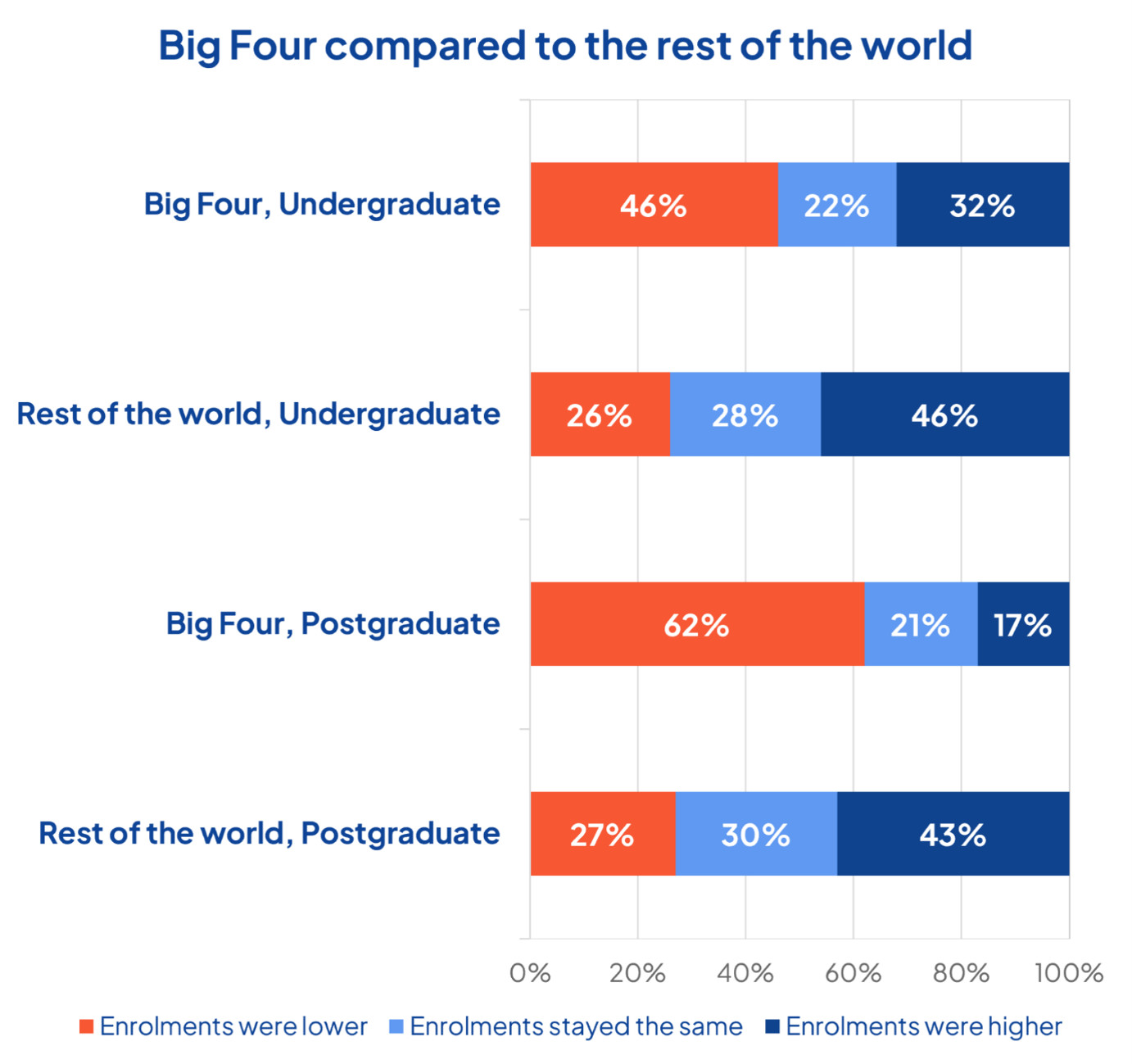
OXFORD, United Kingdom [12 November] 2026 – Most of the 264 ‘Big Four’ (US, UK, Canada, Australia) institutions surveyed in the Global Enrolment Benchmark Survey (62%) saw international enrolments fall in this intake. In the rest of the world, across 173 institutions, the most common result was growth: 43% saw enrolments rise.
The survey, run by Studyportals in partnership with NAFSA: Association of International Educators and Oxford Test of English, gathered responses from 437 universities in 63 countries on new international enrolments for the August to October 2026 intake.
Visa restrictions and restrictive government policies are the single biggest obstacle to international student recruitment. Seven in ten respondents (73%) who answered the question ‘What had the biggest negative influence on enrolments?’ mentioned visas or government policy. Many describe the damage after admission: a shortage of visa appointments, longer vetting and slower permits pushed students past the start date, turning offer holders into deferrals, late arrivals or no-shows.
Others describe it before students apply. Changes to post-study work rules and proposed new fees lowered the expected return on study and cooled enquiries, especially for graduate study.
UK sees the sharpest postgraduate decline
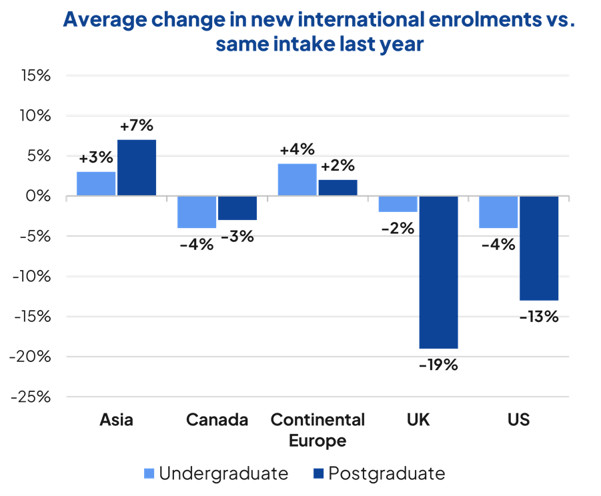
Four in five UK institutions (79%) reported lower postgraduate enrolments, up from 50% a year earlier, with an average decline of 19%. One UK university respondent said, “Visa restrictions had the most negative influence on enrolments along with cost of living globally and shifting policy changes.”
Another cited “growth in visa refusals based on subjective credibility interviews, particularly in light of new BCA metrics”, referring to the tighter Home Office compliance thresholds.
Canada shows signs of stabilising
After two years of steep declines, Canada showed signs of stabilising. Institutions reported average falls of just 4% in undergraduate and 3% in postgraduate enrolments, while more than half said postgraduate numbers were unchanged.
Canadian institutions are also the most optimistic about the future, with 71% expecting t enrolments to grow.
US universities remain cautious
In the US, 59% of institutions reported falling postgraduate enrolments, with an average decline of 13%. This marks a third difficult autumn in a row. US institutions are also the most pessimistic, 37% expect a decline in enrolments for the same intake next year.
One US university warned that it is forecasting a decrease “especially if the Duration of Status rule and OPT fee rule actually go into effect”. One US university told the survey that proposed fees for OPT, STEM OPT and H-1B visas are “cooling interest in study in the US”, with a drastic decline in enquiries for US graduate study.
Asia and Continental Europe see higher enrolments
Institutions in Asia and Continental Europe moved in the opposite direction. 59% of Asian institutions reported higher postgraduate enrolments, where the average change was a rise of 7%. Six in ten Asian universities predicted enrolment growth for the same intake next year.
Institutions in Continental Europe saw postgraduate enrolments rise by an average of 2% with Undergraduate enrolments up 4%
What institutions control still makes a difference
Despite the external pressures, the survey found that positive results were mostly linked to what institutions themselves did. Among those who named a positive influence on enrolments, seven in ten credited an action of their own. Recruitment activity, staffing and travel topped the list, followed by branding and strategic marketing, academic offer and programme quality, personalised communication with applicants, and scholarships.
Looking ahead
Diversification into new markets is the most anticipated plan (43%, up from 40%), rising to 63% among UK institutions. Budget cuts are the second most common expectation (30%, up from 26%).
Dr Fanta Aw, PhD, Executive Director and CEO of NAFSA: Association of International Educators, says:
These survey results affirm what we’ve observed before: national policies matter to international students making major decisions about where to study, conduct research, or start a career. We continue to be encouraged by institutions that are navigating the current instability with innovation and creativity, just as we remain committed to using every available lever to ensure that international students continue to have the option to come to the United States. Their ability to do so benefits students and families and the United States.
Edwin van Rest, CEO and Co-Founder of Studyportals, says:
The global shift in international student flows is continuing, particularly in postgraduate programmes—the very programmes that play the biggest role in attracting the talent countries need to remain competitive. Asian and European destinations continue to grow, partly because they recognise the value of that talent. Canada’s stabilisation is an encouraging sign, with prospects for renewed growth, albeit from a much-reduced base. The message for host countries is clear: welcoming international students is an investment in their own future competitiveness.
Sara Pierson, Managing Director English Assessment, Oxford University Press, says:
The latest Global Enrolment Benchmark Survey highlights a sector that continues to adapt to a changing international landscape. The findings show a varied picture, reinforcing the need for timely data to support planning and decision-making. While challenges and opportunities differ by market, the findings show that institutions continue to take proactive steps to attract and support international students. By providing insight ahead of official statistics, the survey helps universities identify emerging trends, benchmark their performance, and respond with greater agility in an increasingly complex global enrolment environment.